TierGuard
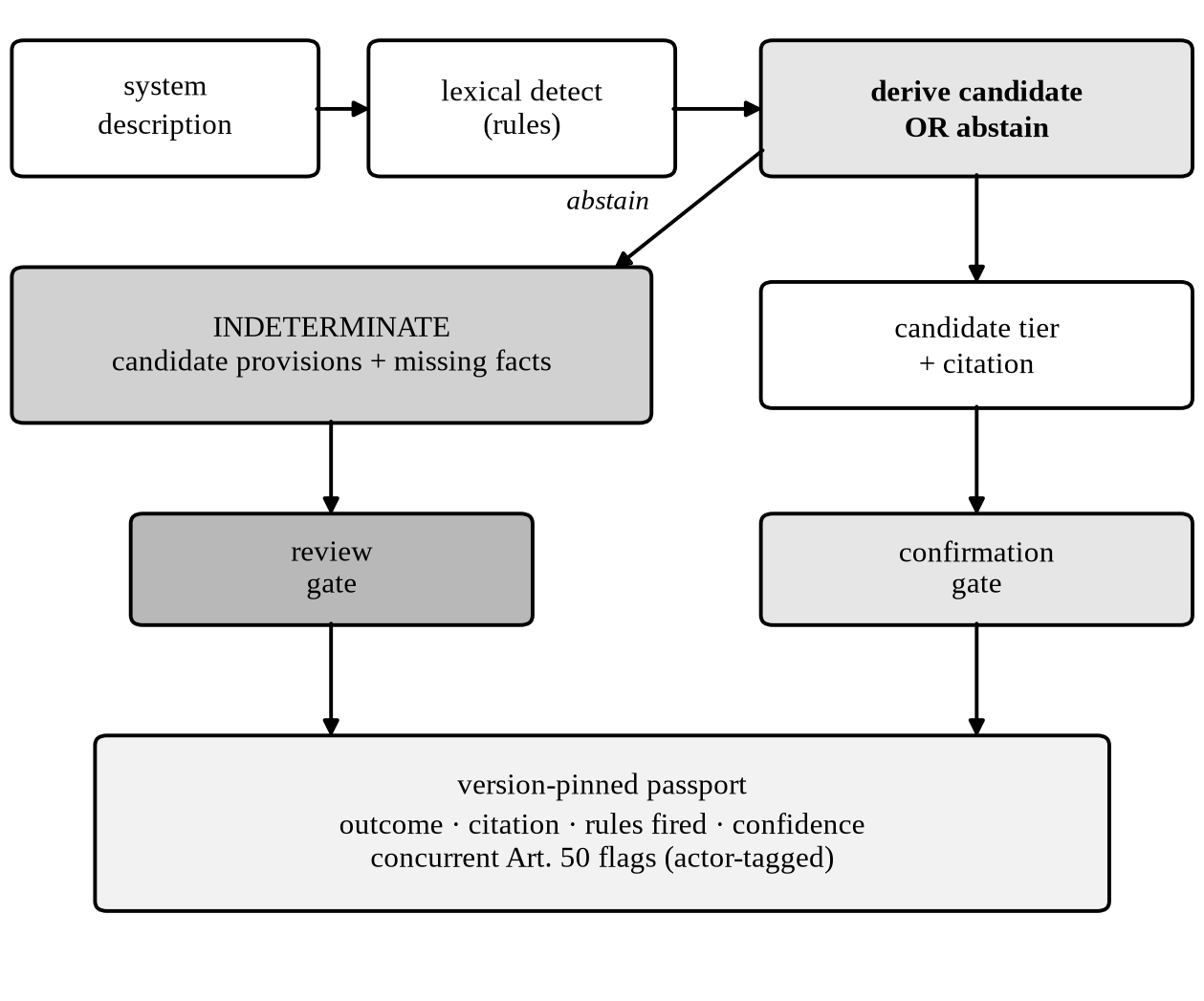
A deterministic triage-and-abstention baseline for the AI Act's Article 5 prohibited practices, Annex III high-risk use-cases and Article 50 transparency duties. From a free-text system description it either issues a candidate tier bound to its governing provision, or returns an INDETERMINATE, review-required outcome carrying candidate provisions and missing facts — deliberately separating workflow escalation from legal conclusion. Annex I product-safety routing is out of scope and every record says so.
The outcome model
One tier-track primary outcome, plus zero or more concurrent Article 50 flags recorded on every outcome (Art. 50(6): transparency duties coexist with higher tiers). Uncertainty is an outcome, never a tier.
Prohibited-candidate
An Article 5 signal fired. If confirmed, the system must not be placed on the market or used. Always escalated for legal confirmation.
High-risk-candidate
A strong Annex III use-case rule fired. Escalated so a human can confirm the tier and check the Art. 6(3) derogation before the Art. 9–15 stack is treated as applicable.
INDETERMINATE
An Annex III context was named without a resolved use-case, or a consequential automated decision about people was detected with no specific rule. Not a finding: a review-required record with candidate provisions and missing facts.
Minimal, with Art. 50 flags
No Art. 5/6 trigger. Article 50 duties — chatbot disclosure, synthetic-content marking, deep-fake labelling — are recorded as concurrent flags with provider/deployer attribution.
What it is — and what it is not
It is pattern-based detection with synonym normalisation over free text, a versioned rule set of 22 rules each bound to the provision it cites, a targeted escalation net for consequential decisions about persons, a machine-readable, version-pinned decision record, and an abstention-aware evaluation protocol that measures error direction, compliance-washing and language collapse. It is released as a baseline for semantic-web and LLM approaches to beat.
It is not semantic understanding, not an impact calculus, and not a legal classifier. On the post-freeze set it silently under-classifies 40% of systems; euphemised descriptions of consequential systems evade its rules; off English, exact agreement collapses. Reference labels are author-assigned; two engine-blind annotators reproduce them at 96% — a practitioner reproducibility check, not legal validation. These figures establish a measured floor and an evaluation protocol for free-text triage, not a deployable screen.
Tools
Live triage
Describe a system and get the full decision record: outcome, citation, rules fired, Art. 50 flags, GPAI status, downstream obligations, and the exact counterfactual — what would lower this outcome, and to what.
Open →Compliance-washing & multilingual
Twenty euphemised descriptions of prohibited and high-risk systems against the hardened engine, its first cycle and the keyword baseline — and the same twelve systems in English, German, French and Arabic.
Open →Results explorer
Every set, every cycle, every metric from the artifact's report — plus the confusion matrix and the penalty-weighted exposure scenarios.
Open →Rule set v0.3.0
All 22 rules with their match expressions and citations, the synonym map, the persons-net, and the GPAI patterns — pinned to the Act as amended.
Open →Cite
R. Kamsheh, "TierGuard: A Deterministic Triage-and-Abstention Baseline for Article 5, Annex III and Article 50 of the EU AI Act," in Proc. 6th Int. Multi-Conf. Artificial Intelligence Technology (MCAIT), Madinah, Saudi Arabia, Nov. 2026.
Proceedings DOI and page numbers will be added once IEEE Xplore publishes the volume.