Results explorer
Abstention-aware, safety-oriented metrics. Annex I product-safety cases are excluded throughout: the engine does not attempt that route and flags it on every record, so scoring them would measure a determination it declines to make.
The metrics, in plain terms
- Correct-or-referred
- correct, or escalated to review — it measures routing, not successful resolution, since the human stage is unevaluated
- Silent
- under-classified and not gated — the unsafe direction, any tier
- Severe silent
- the subset whose reference is high-risk or prohibited
- Gate rate
- share of systems escalated to a human (confirmation or review)
- Coverage
- share decided, i.e. not INDETERMINATE
- Exact
- exact-tier agreement over all systems
Reference labels are author-assigned; the draft-guideline labels inherit that draft's non-binding, interpretive status; the real-system set is small and author-selected; the evaluation set is development-influenced, hence the post-freeze primary. The engine has no run-to-run variance; benchmark-sampling uncertainty remains, and is reported as Wilson intervals.
Per set (Table II)
Hardening ablation
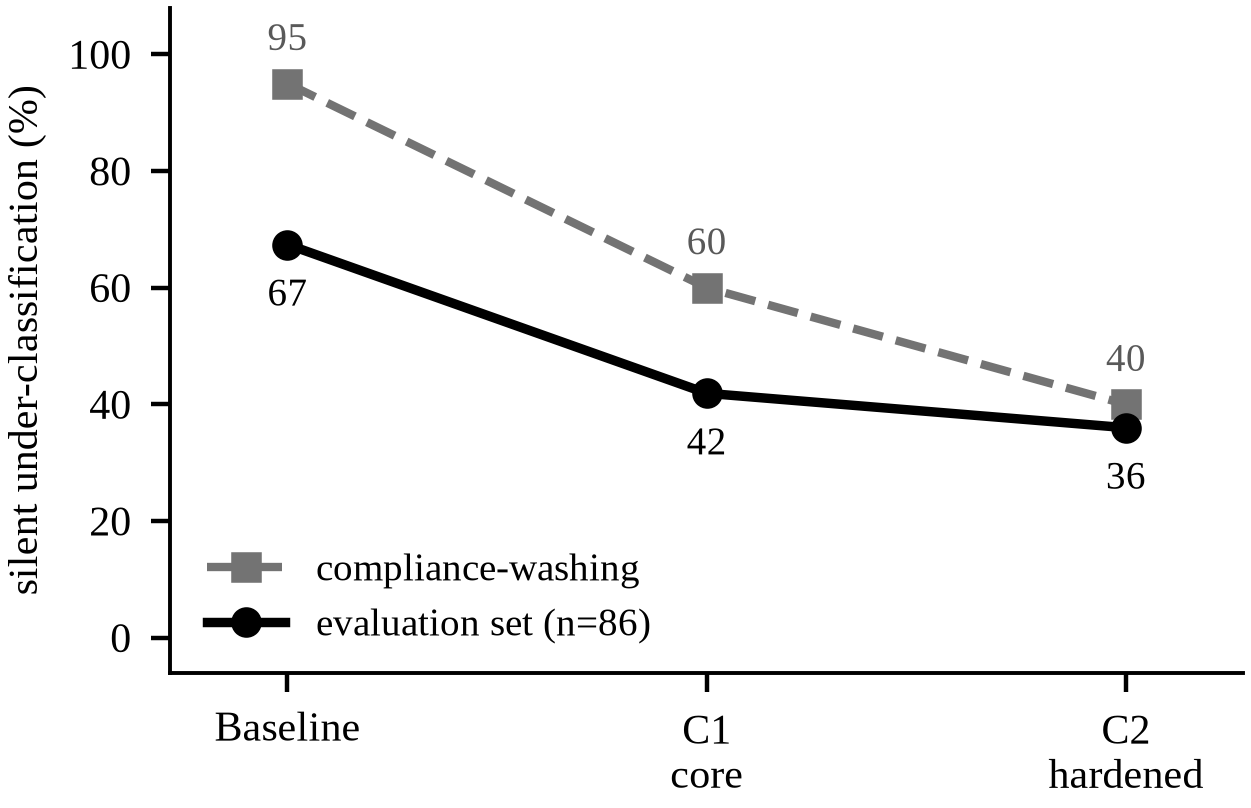
Cycle 2's two components — synonym normalisation and the persons-net — cut compliance-washing slip-through and post-freeze silent under-classification. The post-freeze change is modest and not statistically distinguishable from chance: two cases improved, none worsened, exact McNemar p = 0.50, and the intervals overlap heavily. The paper reports it as a direction, not a demonstrated effect.
Post-freeze confusion matrix (decided cases, Cycle 2)
Rows are reference tiers, columns the engine's decided tier; INDETERMINATE outcomes are abstentions and sit outside the matrix.
Two-annotator reproducibility check (Section IV-D of the paper)
Two annotators — a data engineer and a data scientist, neither a legal practitioner — independently labelled 57 system descriptions (tier, provision, Article 50 set) from a written guide, blind to the engine and to each other; agreement was computed before adjudication and the engine run only after the agreed labels were fixed.
| Measure | Result | Reading |
|---|---|---|
| Tier agreement between annotators | 56 / 57 · κ = 0.971 | wherever both named a provision they named the same one (28 / 28) |
| Author's tier labels reproduced on the 52 agreed units | 50 / 52 (96.2%) | Wilson 95% CI 87–99%; both exceptions the author tiered stricter (high) than the annotators (minimal) |
| Engine on the same 52 units, author's labels vs agreed labels | identical | 16 / 52 silent, 35 / 52 safely handled under either — whose labels are used changes nothing about how the engine scores |
| Unresolved rows | 5 | deliberately not adjudicated; four turn on whether Article 50 duties survive an Article 5 prohibition, which the Regulation does not settle |
Two limits bound this check, in the paper's own words: the annotators are practitioners, so agreement establishes reproducibility, not legal correctness; and the guide as issued carried an Article 6(3) instruction error that could only have pushed labels towards high, so these are round-1 estimates, exposed on the 19 units both labelled high and to be re-run first under the corrected guide. The study package — both guides, scorer, agreed labels, unresolved rows — ships with the artifact.
Penalty-weighted exposure
Illustrative weights proxying the Act's Art. 99 penalty asymmetry — a silent prohibited miss costs far more than a gated one or an over-tier. The claim of record is exactly the paper's: lower engine exposure than the keyword baseline in all four tested scenarios, not a liability estimate.